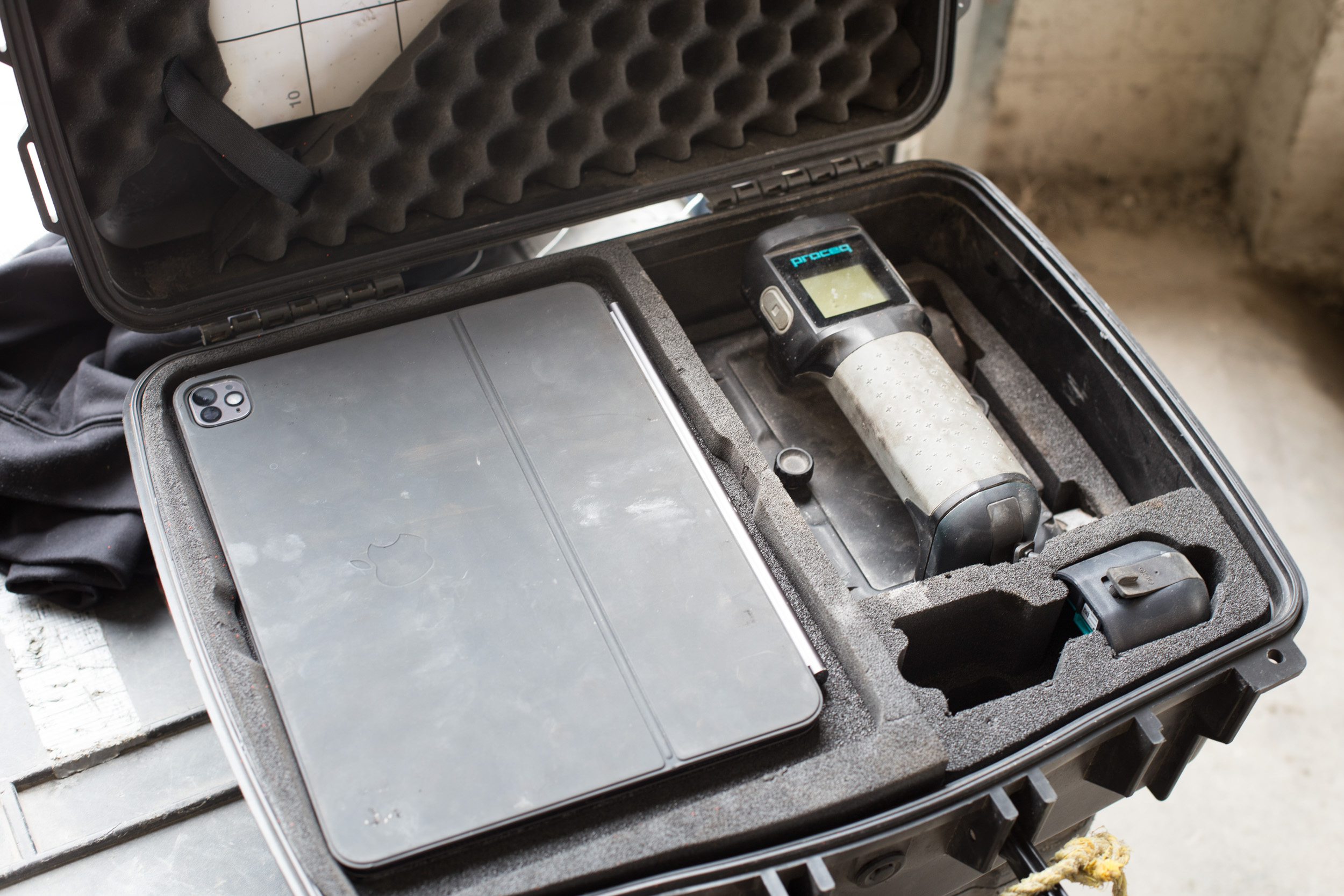
Historically, "X-ray" meant exactly that — a radioactive source on one side of a slab, film on the other, and everyone cleared out of the zone while the exposure ran. For the vast majority of construction scanning today, modern ground-penetrating radar delivers the same information faster, safer, and without evacuation. CDS provides concrete imaging that replaces X-ray workflow on almost every Ontario job site.
X-Ray vs. Modern Concrete Imaging
Traditional radiography is still used in a narrow band of applications — typically when both sides of a slab are accessible and extremely high resolution is needed. For most pre-cut, pre-core, and pre-anchor scanning, GPR is the superior choice:
- No radiation exposure. GPR uses non-ionizing radio waves. No site shutdown, no lead shielding, no regulatory reporting.
- One-sided access. GPR only needs the top surface. Radiography needs both sides of the slab — rarely available on grade or in occupied ceilings.
- Instant results. Findings are visible to the operator and marked on the slab within minutes.
- Lower cost. Mobilization, licensing, and shift rescheduling costs drop significantly.
Our GPR scanning services cover the full spectrum of concrete imaging needs.
What Concrete Imaging Detects
- Rebar size, spacing, and cover depth
- Post-tension cables and anchor heads
- Electrical conduit, data cables, and plumbing
- Voids, honeycombs, and delaminations
- Slab thickness variations and embedded inserts
- Metallic and non-metallic embedments alike
When X-Ray May Still Be Preferred
A few situations favour traditional radiography: specialized engineering investigations of complex embedments, forensic evaluations with access to both faces, and situations where project specifications explicitly call for X-ray. For those, we partner with certified radiography firms so the project has a single point of contact. In most cases, however, GPR imaging satisfies the intent of an X-ray specification — we can help you update the specification with the engineer of record.
Our Scanning Workflow
Site walk and grid
Scan targets are laid out and gridded. Slab is inspected for dampness, which affects signal quality.
Orthogonal passes
Scans run north-south and east-west across the target area. Rebar and PT cables present as hyperbolic reflections at their true depth.
Mark the slab
Findings are marked directly on concrete. Each line type is colour-coded; depths are written alongside.
Deliver the report
Where scope requires, we produce an annotated PDF report with scan images, depths, and site photos.
Serving Hamilton and All of Ontario
From our Hamilton shop at 276 Ferrie St E, crews reach Burlington, Oakville, Mississauga, Toronto, Brampton, Kitchener-Waterloo, Guelph, Cambridge, St. Catharines, Niagara, London, and every point between. For projects in Northern Ontario, Eastern Ontario, or remote sites, we mobilize with self-contained power and water so work does not stall on access.
X-Ray and Imaging FAQ
Is GPR as accurate as X-ray?
For rebar location, PT cable location, and conduit mapping — yes, within practical construction tolerances. X-ray may offer finer detail on complex embedments where both faces are accessible.
Do we need to evacuate during scanning?
No. GPR is non-ionizing; work continues around the scan area.
How long does a typical scan take?
A single core location takes minutes; a full floor scan for pre-construction mapping can take hours to days depending on area.
Can you scan through finishes?
Through most tile, carpet, and thin toppings, yes. Thick epoxy coatings and reinforced topping slabs may need a pass with the coating removed.
Do you carry engineering-grade equipment?
Yes. Our GPR units meet the reporting and resolution needs of commercial engineering, municipal, and bridge inspection scopes.
Specifying Imaging on New Projects
Older engineering specifications still call for "X-ray inspection" on concrete penetrations. New specifications increasingly say "imaging by GPR or equivalent non-destructive method" — recognizing that GPR meets the intent without the radiation management burden. If your project specification requires X-ray specifically, talk to your engineer of record about equivalency; in most cases GPR satisfies both the technical and the liability requirements.
Combining Imaging With Coring
The most efficient workflow on most projects is a single mobilization that scans, marks, and then cores. We arrive with imaging and coring equipment on the same truck. Scan flags the safe path; the operator cores immediately; the next trade gets a clean hole within the hour. Splitting these between two contractors adds a half-day minimum and creates a handoff gap where information gets lost.
Is a report always required?
No. Most routine pre-core scans are marked on the slab only. Engineering, insurance, and permit scopes typically require a written imaging report.
Replace X-ray with faster, safer GPR imaging
Concrete Drilling & Sawing Ltd. (CDS) has served Hamilton and all of Ontario since 1967. Licensed, insured, and ready to mobilize on short notice — residential, commercial, and industrial.
Phone: (905) 529-6029 | Toll-Free: 1-800-241-5708
Shop: 276 Ferrie St E, Hamilton, ON L8L 3T7 · View on Google Maps
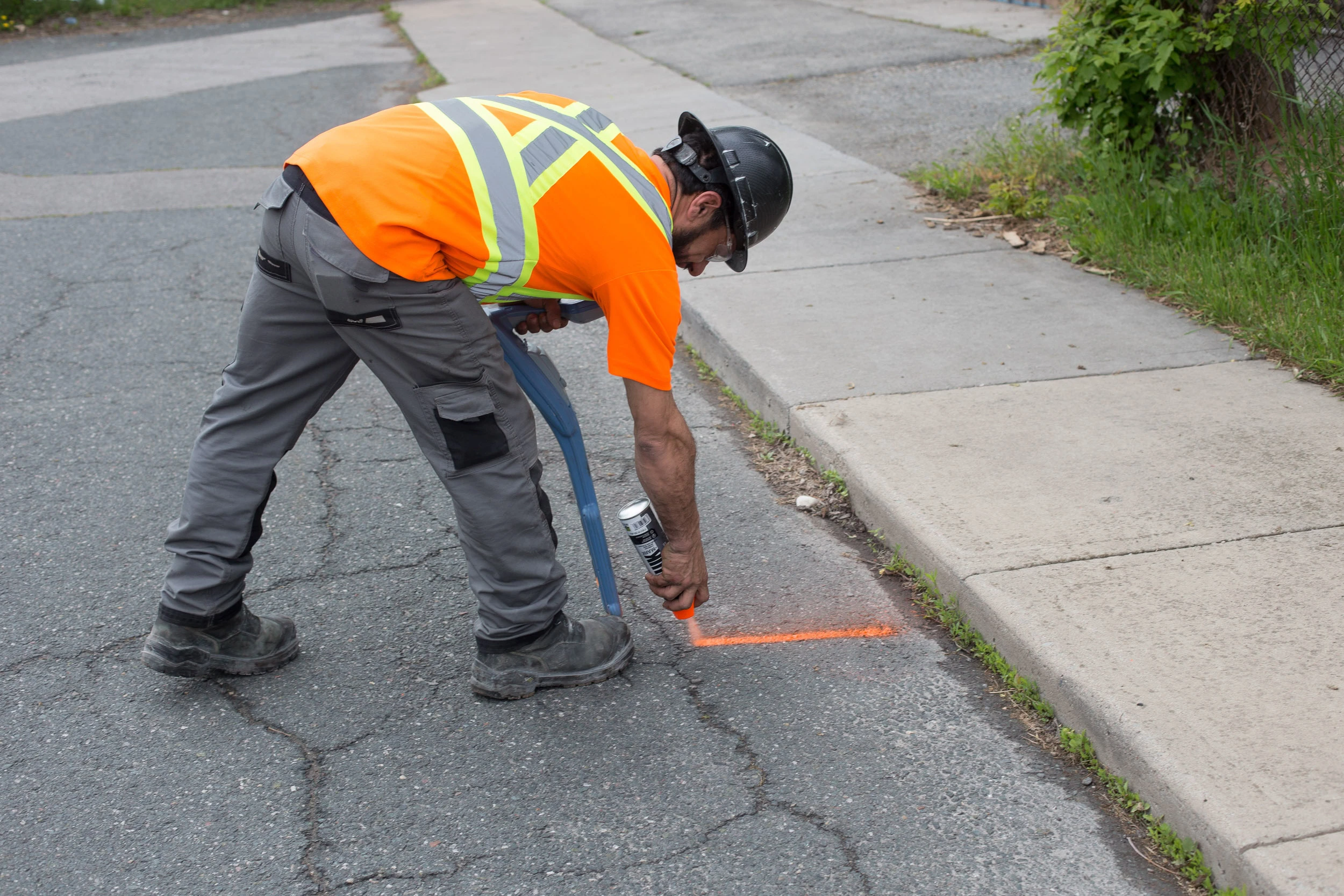
This service falls under the GPR services hub. Below are the most directly related services from the same team — and a couple from our other practice area when the work overlaps.
Related Services
Closely related services within our team’s day-to-day scope:
Worth knowing about, on the scanning / demolition side:
Quotes by phone: (905) 529-6029 (Hamilton) or 1-800-241-5708 (toll-free across Ontario).
Based in Hamilton, CDS serves projects across Ontario — see our Ontario service areas, including concrete contractor service in Brantford, Niagara Region and Peel Region.
More on this topic: GPR and concrete scanning guides from the CDS blog.