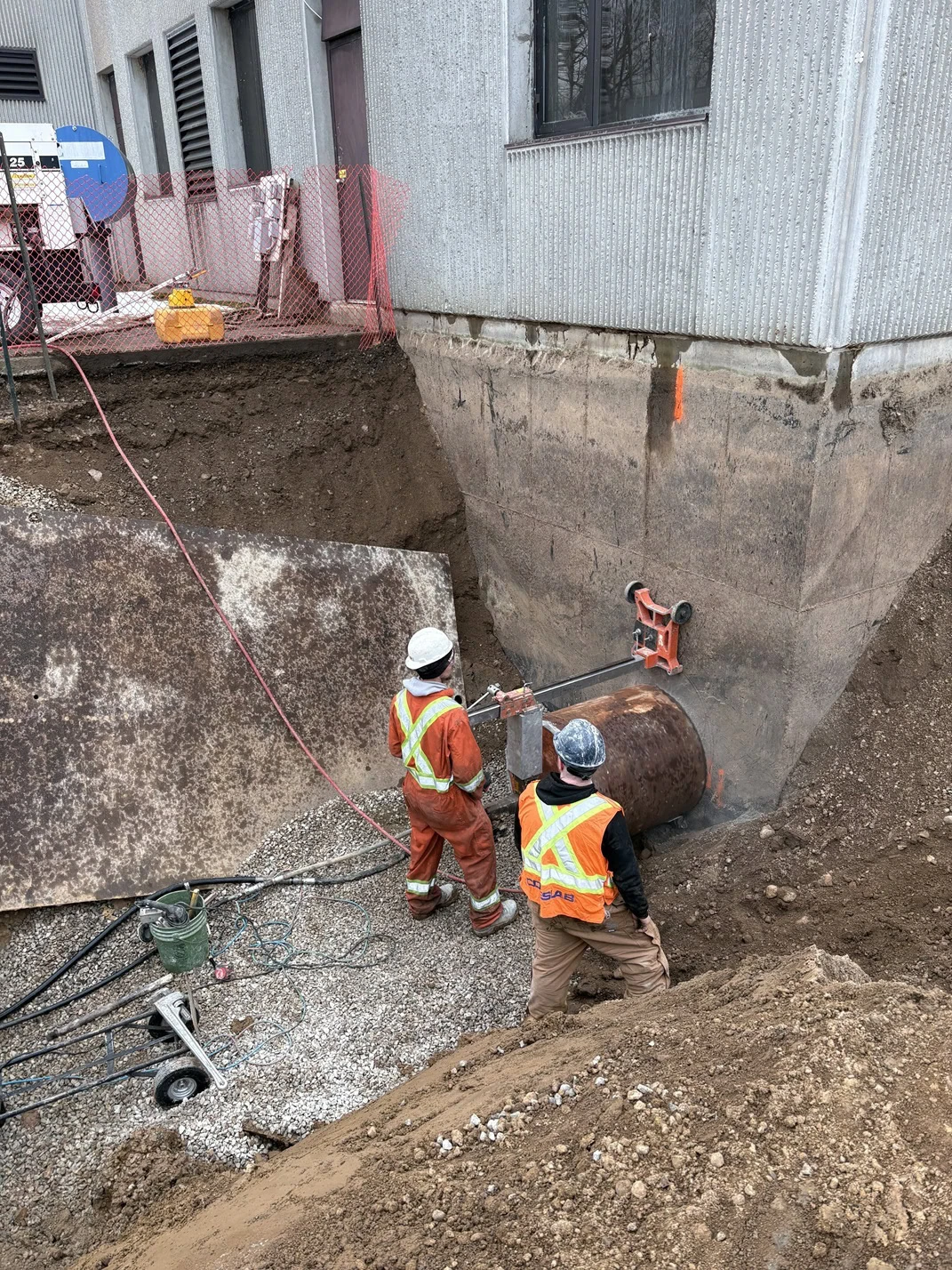
Concrete coring cuts clean, round holes through slabs, walls, beams, and foundations for every trade that follows. Plumbing risers, electrical conduit, HVAC sleeves, structural anchors, testing cores — if the job needs a precise hole through hardened concrete, CDS has the core barrel that fits. Our fleet covers 1-inch pilot holes up to 60-inch diameter cores, in any orientation, through any thickness.
Concrete Coring Applications
- Plumbing risers and drain penetrations in slabs and shear walls
- Electrical conduit and data cable routing between floors
- HVAC ducts, sleeves, and vents through foundation walls
- Structural anchor holes for steel column bases and machine mounts
- Sample cores for CSA and engineering compressive-strength testing
- Inspection cores to verify slab thickness or sub-base condition
- Sprinkler and fire-suppression pipe penetrations
Our Core Drilling Equipment
Small cores (1" to 6")
Hand-held and rig-mounted drills for plumbing and electrical work. Fast, accurate, minimal footprint.
Mid-size cores (6" to 18")
Rig-mounted electric or hydraulic core drills with vacuum or anchor mounts. Vertical, horizontal, or overhead.
Large cores (18" to 60")
Big-bore rigs for elevator pits, sump drains, manhole penetrations, and heavy mechanical shafts. Water-cooled diamond barrels cut through heavily reinforced concrete.
Our Coring Process
Scan the core location
We run GPR scanning on every structural core. Hitting rebar is survivable; hitting a post-tension cable is not. Scanning lets us shift the core a few inches and keep the structure intact.
Set the rig
Anchor-mount or vacuum-mount, plumb and square. Operator checks depth gauge, water feed, and slurry containment.
Drill and extract
The barrel cuts through; the slug drops out clean. Water feed keeps the diamonds cutting, slurry stays in the containment tray.
Clean-up
Slurry vacuumed at the source, core slug removed, edges touched up if spec requires it. The next trade can fit their pipe, conduit, or anchor immediately.
Why CDS for Core Drilling
Core drilling looks simple from the outside. Experience shows up when things go sideways — rebar is denser than the drawings said, slab is thicker than marked, or the structural engineer changes the location after shoring is up. CDS operators solve those problems on the spot instead of calling the office to ask. Fifty-eight years of cores has built the intuition.
We also drill clean. Slurry that escapes into finished areas is the most common complaint about core drilling on occupied buildings. Our vacuums and containment handle that.
Serving Hamilton and All of Ontario
From our Hamilton shop at 276 Ferrie St E, crews reach Burlington, Oakville, Mississauga, Toronto, Brampton, Kitchener-Waterloo, Guelph, Cambridge, St. Catharines, Niagara, London, and every point between. For projects in Northern Ontario, Eastern Ontario, or remote sites, we mobilize with self-contained power and water so work does not stall on access.
Concrete Coring FAQ
How big of a core can you drill?
Up to 60 inches in diameter. For anything larger we switch to saw cutting a square opening and removing the slug.
Do you scan every core?
Any core in a structural slab, beam, or PT deck gets scanned. Non-structural curb or pad cores usually do not need it.
What about overhead coring?
Yes. We core upward through slabs and beams with ceiling-anchored rigs. Water recovery is the tricky part and we handle it.
Can you core through post-tensioned slabs?
Yes — with a scan first, and the engineer’s approval on location. PT slabs are the exact reason GPR scanning exists.
How deep can you core?
With barrel extensions we core through thicknesses over 10 feet. Most buildings fit well within standard barrel lengths.
Typical Core Drilling Rates
Pricing depends on diameter, depth, rebar density, access, and mobilization. As a planning range: 4-inch through-slab cores on a 6-inch slab run one flat rate; 12-inch cores through a heavily reinforced foundation wall run several times that. Mobilization is charged once per trip, which is why batching cores from multiple trades into one mobilization saves real money. We will happily coordinate that across project teams when asked.
Core Sample Testing
Cores taken for compressive-strength testing need extra care: diamond-saw trim, capping, and curing per CSA A23.2. We coordinate with CSA-certified testing labs on sample handling and chain-of-custody so the results stand up to engineering scrutiny. For forensic cores — investigating spalled decks, suspected freeze-thaw damage, or failed repairs — we collect larger-diameter samples that let the lab assess aggregate distribution and microcracking.
Can you core at odd angles?
Yes. Standard rigs handle vertical, horizontal, and overhead. Angled cores (through sloped slabs or into walls at non-right angles) need custom setup but are within scope.
Book clean, precise concrete coring
Concrete Drilling & Sawing Ltd. (CDS) has served Hamilton and all of Ontario since 1967. Licensed, insured, and ready to mobilize on short notice — residential, commercial, and industrial.
Phone: (905) 529-6029 | Toll-Free: 1-800-241-5708
Shop: 276 Ferrie St E, Hamilton, ON L8L 3T7 · View on Google Maps
This service falls under Hamilton concrete cutting. Below are the most directly related services from the same team — and a couple from our other practice area when the work overlaps.
Related Services
Common companion services your project may need:
- floor and joint sawing
- controlled concrete demolition
- cut-and-lift removal
- patch and slab-section replacement by others
Cross-discipline services we run alongside this one:
Quotes by phone: (905) 529-6029 (Hamilton) or 1-800-241-5708 (toll-free across Ontario).
Based in Hamilton, CDS serves projects across Ontario — see our where we work across Ontario, including concrete contractor service in Niagara Region, Peel Region and Waterloo Region.
More on this topic: core drilling and cutting guides from the CDS blog.