
Wire sawing is the method we reach for when a standard saw blade simply cannot get the job done — through mass concrete, deeply reinforced sections, bridge and pier structures, or awkward geometry a rigid blade can never wrap around. Concrete Drilling & Sawing Ltd. (CDS) has provided wire sawing across Hamilton and all of Ontario since 1967, using a diamond-plated cable that slices concrete and embedded steel in a single pass with low vibration and a clean, controlled result.
What Is Wire Sawing?
Wire sawing uses a continuous loop of diamond-beaded cable that runs around a set of pulleys and is drawn through the material under tension by an electric-hydraulic drive wheel. Because the cutting element is a flexible wire rather than a fixed blade, it can be routed around corners, threaded through drilled access holes, and wrapped around a section of virtually any thickness. Where a wall saw or floor saw runs out of depth, wire sawing keeps going.
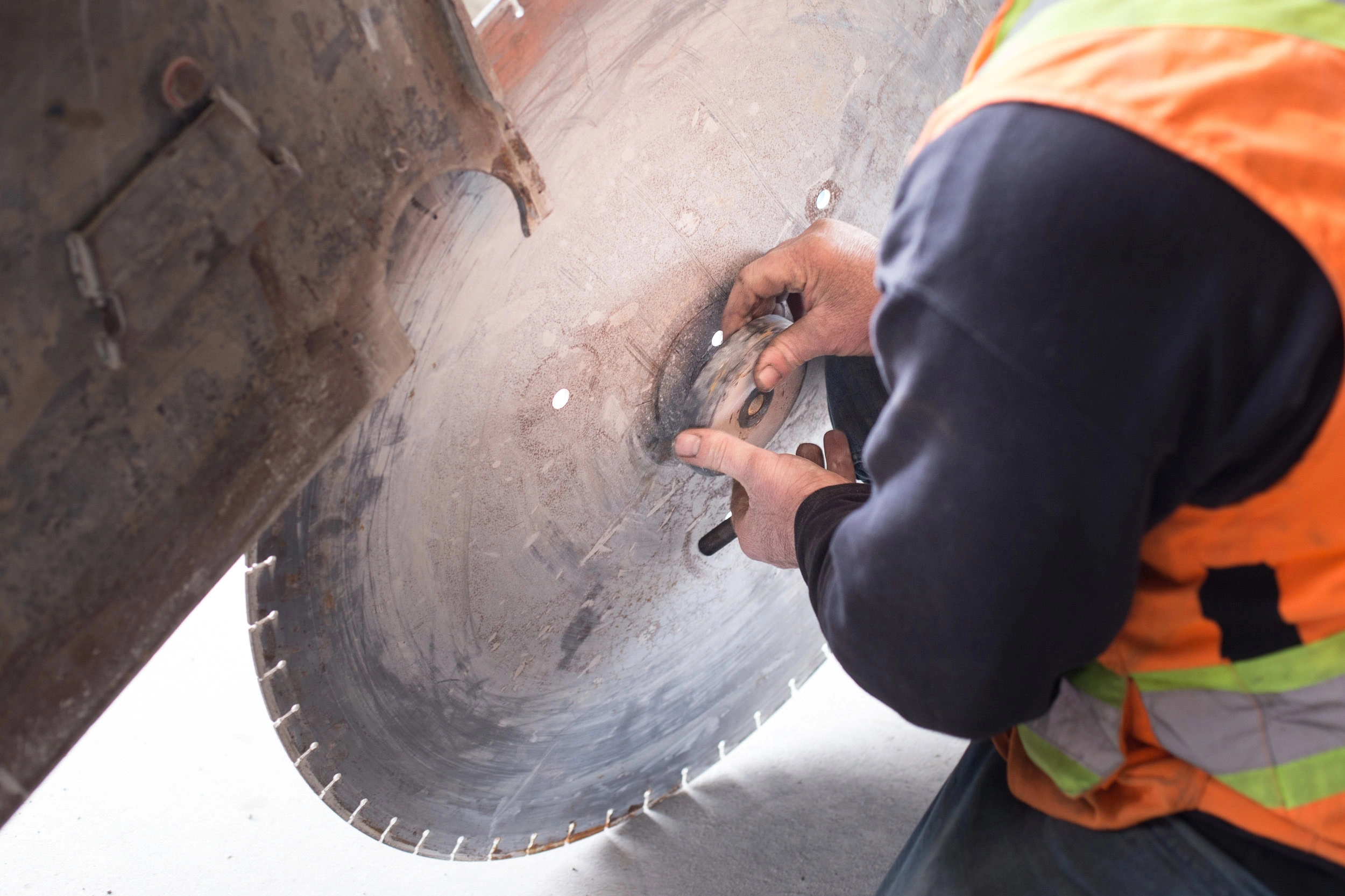
The technique is valued for three things: reach, section size, and the ability to cut heavily reinforced concrete and solid steel together. It sits within the full range of concrete cutting services CDS provides. Importantly, a wire saw creates openings and separates large masses for removal — it does not build, replace, or restore anything.
- Cuts mass and thick concrete with no practical depth limit
- Handles heavily reinforced sections and embedded steel
- Follows irregular shapes, curves, and hard-to-reach angles
- Produces low vibration to protect surrounding structure
- Runs quietly on electric power for occupied buildings
How CDS Performs Wire Sawing
A wire saw job is methodical. Rigging the pulleys correctly and reading what is inside the concrete are what separate a clean, safe cut from a costly one. Our crews follow the same disciplined sequence on every project.
Scan and plan
Before any cutting begins, we run a GPR scan to locate rebar, post-tension cables, conduit, and voids. Scan-before-cut is standard practice at CDS, and on wire work it also confirms the safest path for the drilled access holes.
Thread the wire and set the pulleys
We drill entry and exit holes, feed the diamond wire through, and close the loop around a system of idler pulleys and the drive wheel. The pulley layout is what lets the wire cut around corners or wrap a full section.
Tension and cut
The drive wheel puts the wire under controlled tension and pulls it through the material while water cools the cable and suppresses dust. Cutting speed is managed so the diamond beads wear evenly and the line of cut stays true.
Rig and remove
Large sections are rigged and lifted out in manageable pieces. When the goal is taking a structure down, wire sawing pairs directly with our concrete removal crews so cut sections leave the site without breaking or hammering.
Cutting Concrete and Steel With Diamond Wire
The feature that sets wire sawing apart is its ability to cut concrete and metal in the same operation. Diamond wire does not care whether it is passing through aggregate, a dense rebar cage, or a solid steel beam — it cuts through all of it on one continuous line. That makes it the right tool for heavily reinforced footings, encased columns, and structures where the steel content would stall a conventional blade.
Because the same setup cuts both materials, wire sawing often overlaps with dedicated steel cutting work — severing embedded plate, pipe, and structural members cleanly and without heat distortion. To be clear about scope: a wire saw separates and opens up steel and concrete for removal or demolition. It does not weld, fabricate, or replace structural members.
Wire Sawing Equipment and Low-Impact Electric Power
Our wire systems run on electric power packs rather than diesel or gas engines. That choice matters on the kind of sites where wire sawing is needed — hospitals, plants, parkades, and occupied commercial buildings.
- Low local emissions: electric power packs produce no engine exhaust at the cut, keeping indoor air clean.
- Low noise: quiet operation is far easier on staff, tenants, and neighbours than percussive breaking.
- Low vibration: the wire shears rather than pounds, so nearby structure and surfaces stay protected.
- Controlled dust: water cooling keeps airborne silica down throughout the cut.
The result is a demolition-grade cutting method that behaves well inside sensitive, occupied spaces — a combination that percussive tools cannot match.
Typical Wire Sawing Jobs and Clients
Wire sawing earns its keep on the jobs other methods cannot touch. CDS is called in by general contractors, demolition firms, engineers, and industrial plant managers for work such as:
- Bridge deck, girder, and pier section removal
- Mass foundations, thick footings, and heavy transfer beams
- Reinforced concrete columns and encased steel members
- Large openings in thick walls for tunnels, shafts, and equipment access
- Underwater and confined-space cuts where a blade cannot fit
- Precision separation of structures for controlled demolition
If a section is too thick, too reinforced, or too oddly shaped for a wall saw, wire sawing is the answer.
Why Choose CDS for Wire Sawing
Wire sawing is a high-tension, high-stakes process, and experience shows. Families and firms across Ontario have trusted CDS with this work for more than half a century.
- Family-run since 1967 — decades of wire, wall, and core experience on the toughest cuts in the province.
- $5 million liability insured and WSIB compliant — the coverage and safety record serious projects require.
- Scan-before-cut standard — every job begins with GPR so nothing inside the concrete is a surprise.
- Clean, low-impact methods — electric power, water cooling, and precise rigging protect your building and your schedule.
Serving Hamilton and All of Ontario
CDS is based at 276 Ferrie Street East in Hamilton (L8L 3T7) and mobilizes across all of Ontario for wire sawing projects. From a single reinforced footing to a full bridge takedown, our crews travel to the site with the rigging, power packs, and diamond wire the job demands. Residential, commercial, industrial, and municipal clients all rely on the same experienced team.
Frequently Asked Questions
What is wire sawing used for?
Wire sawing is used to cut very thick, mass, or heavily reinforced concrete, to cut embedded and structural steel, and to follow irregular shapes where a rigid blade cannot reach. It is a go-to method for bridges, piers, mass foundations, and controlled demolition.
Can wire sawing cut steel as well as concrete?
Yes. Diamond wire cuts concrete, rebar, and solid steel on the same continuous line, which is why it is the preferred tool for heavily reinforced or steel-encased sections. It separates and opens material for removal — it does not fabricate or replace structural members.
Is there a thickness limit to wire sawing?
There is no practical depth limit. Because the wire wraps around the section rather than plunging in like a blade, it can cut through material several feet thick that a wall or floor saw could never reach.
Is wire sawing safe for occupied buildings?
It is well suited to occupied spaces. Our wire systems run on electric power packs for low local emissions, produce low noise and vibration compared with breaking, and use water cooling to control dust throughout the cut.
Do you scan before wire sawing?
Always. Every CDS wire job starts with a GPR scan to map rebar, post-tension cables, and conduit so we can plan safe access holes and cut lines before any tension is applied.
If you are new to the method, this overview of how a diamond wire saw works explains the diamond-wire-and-pulley cutting we run.
Need wire sawing in Hamilton or anywhere in Ontario?
Concrete Drilling & Sawing Ltd. (CDS) has served Hamilton and all of Ontario since 1967. Licensed, insured, and ready to mobilize on short notice — residential, commercial, and industrial.
Phone: (905) 529-6029 | Toll-Free: 1-800-241-5708
Shop: 276 Ferrie St E, Hamilton, ON L8L 3T7 · View on Google Maps