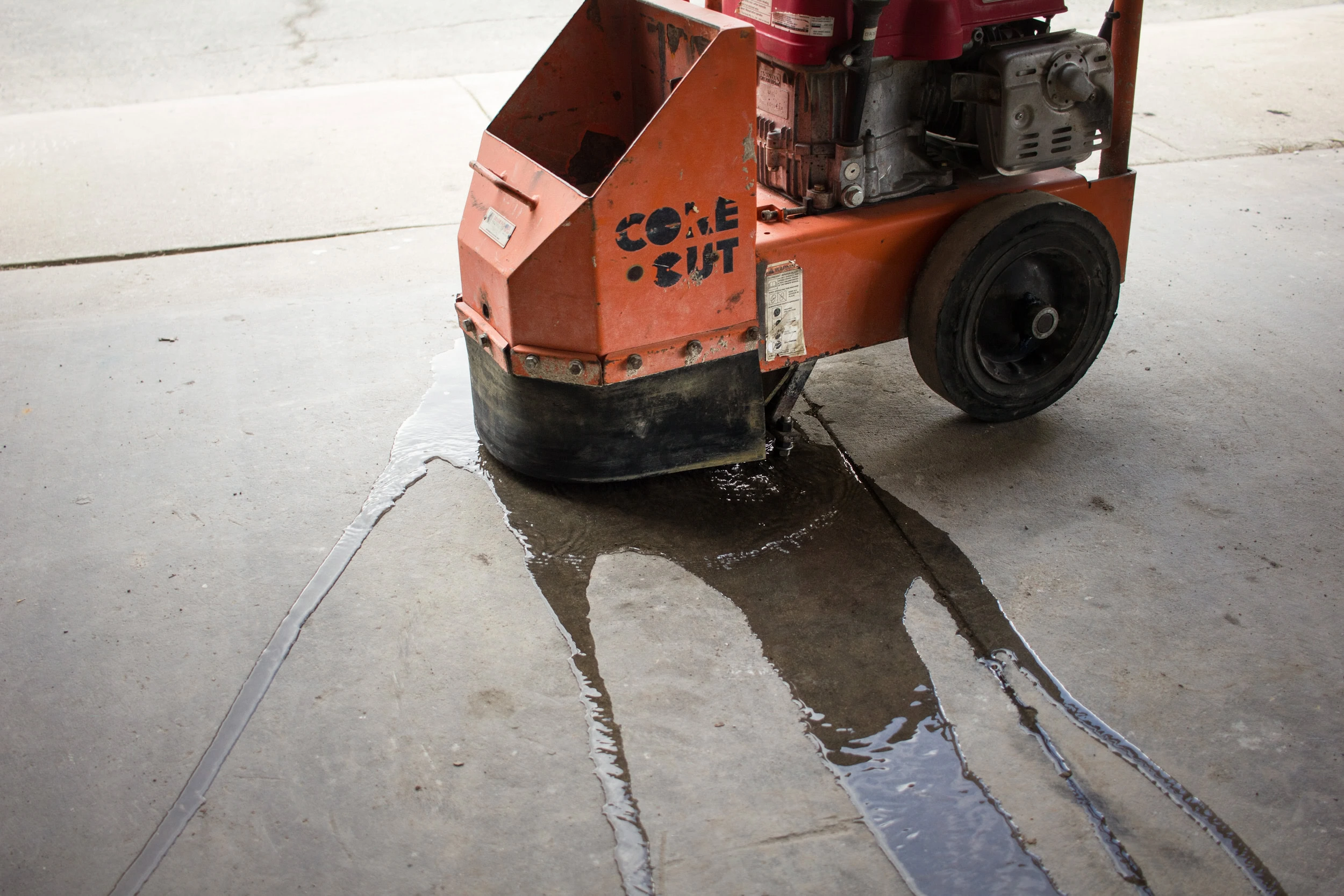
Concrete grooving cuts shallow, parallel lines into hardened slabs to restore traction on surfaces that have gone slick with age, polish, or weather. CDS grooves ramps, loading docks, parking garages, walkways, and bridge decks across Ontario with diamond-blade gang saws — the same technique used by highway agencies to add friction to bridge decks without resurfacing them.
Where Grooving Solves a Real Problem
- Parking garage ramps and decks that ice over or collect oil and water
- Loading docks where forklifts lose grip under load
- Exterior sidewalks and entrances that need slip resistance under rain or snow
- Polished concrete walkways where polish has gone too glossy
- Food and beverage floors with wet-process areas that require slip certification
- Bridge decks to improve skid resistance between full resurfacings
Types of Concrete Grooving
Longitudinal grooving
Continuous straight grooves along the direction of travel. Common on ramps and parking decks — water flows along grooves off the deck rather than across the travel lane.
Transverse grooving
Grooves cut across the direction of travel. Best for high-friction demands like heavy forklift zones and brake-approach lanes.
Diamond-pattern grooving
Two passes at ninety degrees. Highest friction coefficient of the three, usually on short, critical sections.
Our Grooving Process
Surface review
We check slab condition. Spalled or cracked concrete may need replacement before grooving. Sound concrete takes grooves cleanly.
Layout and spacing
Typical groove spacing is 3/4 inch on centre; depth is 1/8 to 3/16 inch. For high-traffic areas we tighten spacing to 1/2 inch and deepen to 1/4 inch.
Cut with a gang saw
A multi-blade diamond gang saw runs the pattern in one pass per line. Water feed suppresses dust; vacuum recovers slurry.
Clean and commission
Grooves are rinsed, slurry is recovered, and the surface is returned to service within hours. For parking garages, lanes are re-opened one at a time so traffic keeps moving.
Grooving vs. Other Anti-Slip Treatments
Coatings and broadcast aggregates wear off. Grooving is permanent — the texture is cut into the concrete itself. For exterior and high-traffic areas, that permanence is usually decisive. For polished-concrete interiors where appearance matters, grooving is more visually subtle than broadcast aggregates but more visible than a clear anti-slip additive in sealer.
Where grooving is paired with control-joint saw cutting, both can run in the same mobilization.
Serving Hamilton and All of Ontario
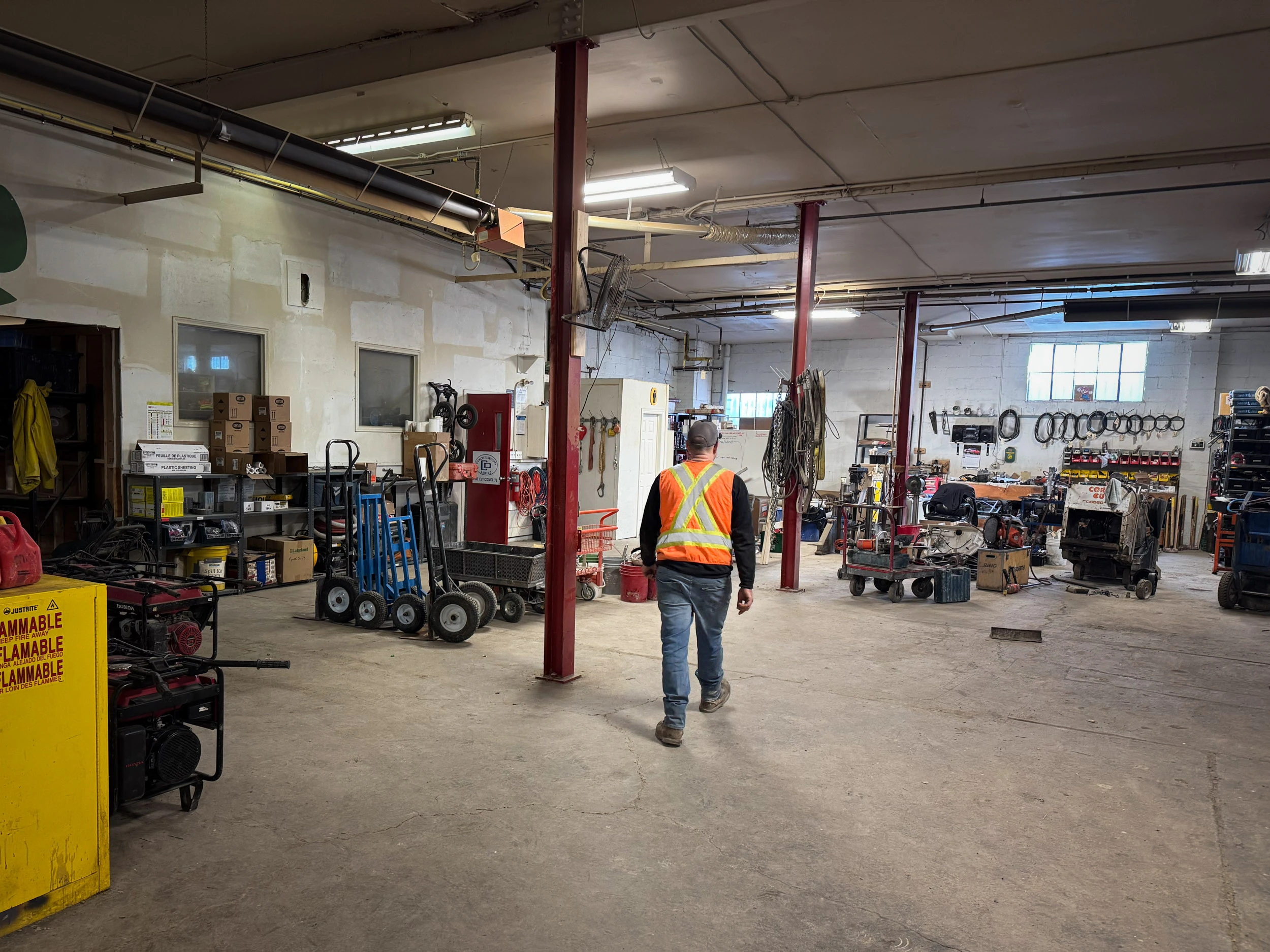
From our Hamilton shop at 276 Ferrie St E, crews reach Burlington, Oakville, Mississauga, Toronto, Brampton, Kitchener-Waterloo, Guelph, Cambridge, St. Catharines, Niagara, London, and every point between. For projects in Northern Ontario, Eastern Ontario, or remote sites, we mobilize with self-contained power and water so work does not stall on access.
Concrete Grooving FAQ
How long does grooving last?
Permanently, on sound concrete. The cut is into the slab — it cannot wear off the way coatings do. Grooves do fill with dirt over years and benefit from periodic pressure washing.
Will grooving damage my slab?
No. Cuts are 1/8 to 1/4 inch deep — far less than a control joint. Structurally, the slab is unaffected.
Is grooving safe on polished concrete?
Yes, though it changes the look. A grooved polished floor reads as striped rather than glassy. We cut test strips first on visible floors.
Can you groove indoors?
Yes — electric gang saws with vacuum recovery keep interior grooving dust-free.
How quickly can a grooved surface be used?
Pedestrian use is immediate after rinsing; vehicle traffic returns within the same day.
Friction Coefficients and Certification
Slip-resistance standards for commercial and industrial floors reference dynamic coefficient of friction (DCOF) thresholds. Most Canadian standards cite 0.42 DCOF wet as the practical minimum for walkways. Polished concrete often falls below that when wet; grooving brings it back up to 0.55-0.65 depending on pattern and spacing. We can test before-and-after with a BOT-3000 tribometer and document compliance for facility managers.
Where Grooving Does Not Solve the Problem
Grooving is a texture fix, not a cleanliness fix. A grooved floor coated in oil or ice will still be slippery — the physics do not change. Pair grooving with proper drainage, cleaning schedules, and de-icing programs for full slip-resistance performance. On parking ramps, that usually means a heated slab, a glycol-based deicer compatible with concrete, and longitudinal grooves to channel melt away from tires.
Can you repair a grooved surface if it gets damaged?
Yes. Spot replacement patches can be grooved to match the surrounding pattern once the new concrete has cured.
Add permanent slip resistance with concrete grooving
Concrete Drilling & Sawing Ltd. (CDS) has served Hamilton and all of Ontario since 1967. Licensed, insured, and ready to mobilize on short notice — residential, commercial, and industrial.
Phone: (905) 529-6029 | Toll-Free: 1-800-241-5708
Shop: 276 Ferrie St E, Hamilton, ON L8L 3T7 · View on Google Maps
This service falls under concrete cutting services. Below are the most directly related services from the same team — and a couple from our other practice area when the work overlaps.
Related Services
Projects that involve this service often also need:
- industrial floor placements
- where we handle saw cuts
- warehouse floor replacement
Worth knowing about, on the scanning / demolition side:
Quotes by phone: (905) 529-6029 (Hamilton) or 1-800-241-5708 (toll-free across Ontario).
Based in Hamilton, CDS serves projects across Ontario — see our service areas across Ontario, including concrete contractor service in Hamilton, Toronto and Ottawa.