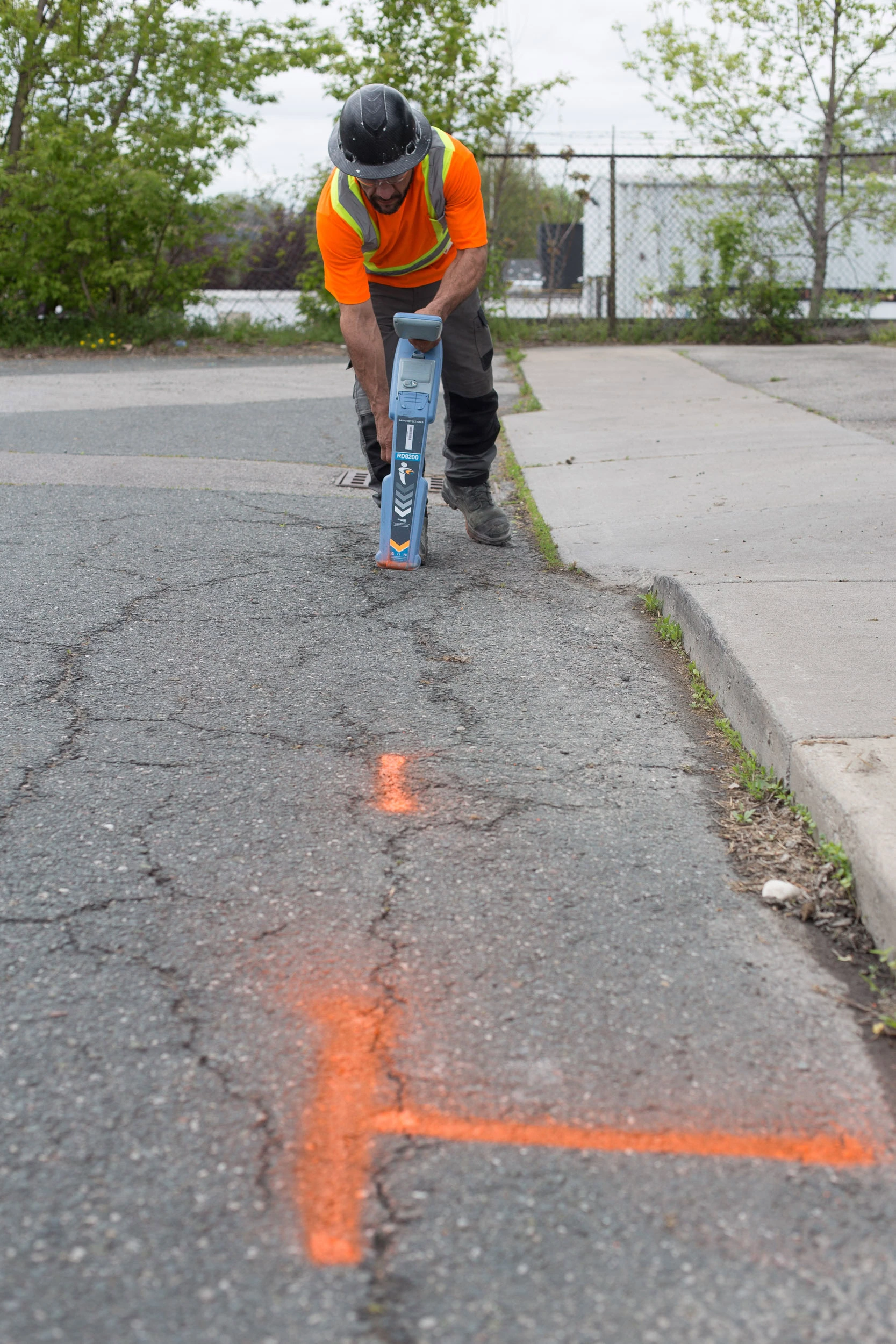
Public utility locates (Ontario One Call) cover utilities owned by the registered utility companies. Everything else — the pipe the building’s plumber ran twenty years ago, the conduit nobody drew on a record, the irrigation line the landscaper installed last season — is your responsibility. CDS handles private utility locating across Ontario using ground-penetrating radar paired with electromagnetic locators so both metallic and non-metallic services are found.
What Utility Locating Finds
- Metallic lines — gas, water mains, steel-cased conduit, grounding, copper water service
- Non-metallic lines — PVC drain, plastic water and gas, fibre optic with no tracer wire
- Cables and conduit in slabs — electrical, data, low-voltage
- Storage tanks, septic beds, and leach fields
- Abandoned infrastructure — old pipes, foundations, and vaults that never made it onto record drawings
Our Technique: Two Methods Are Better Than One
Electromagnetic (EM) locating
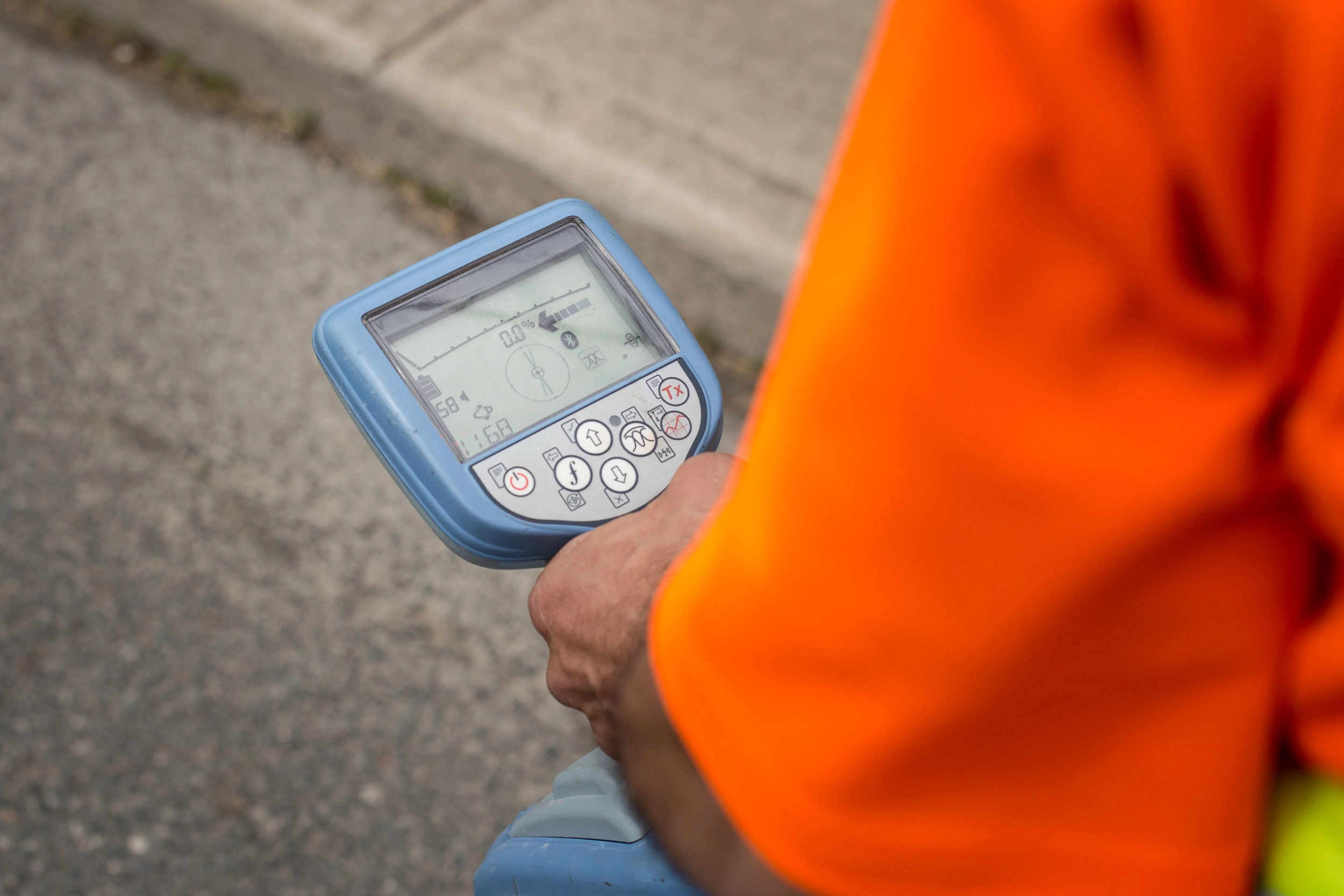
A transmitter applies a signal to a metallic line; a receiver traces the path and marks depth. Fast and accurate on metallic and tracer-wired utilities.
Ground-penetrating radar
Radio pulses reflect off any density change underground — metallic or not. GPR finds the PVC that EM cannot see. See our GPR services for details.
Running both gives you a composite map that neither method produces alone. This matters on sites where plastic and metallic services are mixed, which is most of them.
When You Need a Private Utility Locate
- Before excavation on private property, behind the building face
- Before coring or drilling into a structural slab over live services
- Before foundation, landscape, or parking-lot work on campuses, industrial plants, and retail properties
- Due-diligence scans prior to property acquisition or redevelopment
- Forensic locating after a strike — mapping what is really there before re-digging
Our Utility Locating Process
1. Pre-job review
We gather available drawings, sketches, and site information. Existing information shortens field time and catches discrepancies early.
2. Multi-method scan
EM sweeps run first on accessible metallic services. GPR fills in the gaps — plastic pipe, voids, and anything not on record.
3. Mark-up
Paint, flags, or chalk marks on the ground; colour-coded by utility type per Ontario One Call conventions.
4. Report
When scope requires, we deliver an annotated plan showing located utilities, depths, and confidence notes.
Why CDS for Private Locating
Private locating firms split into two camps: pure locators without cutting experience, and cutting crews without locating depth. CDS has both under one roof since 1967. When your locate turns into a live cutting or demolition job, the same company that scanned can execute.
Serving Hamilton and All of Ontario
From our Hamilton shop at 276 Ferrie St E, crews reach Burlington, Oakville, Mississauga, Toronto, Brampton, Kitchener-Waterloo, Guelph, Cambridge, St. Catharines, Niagara, London, and every point between. For projects in Northern Ontario, Eastern Ontario, or remote sites, we mobilize with self-contained power and water so work does not stall on access.
Utility Locating FAQ
Do I still need to call Ontario One Call?
Yes. Ontario One Call (public locate) is legally required before excavation on public-utility-owned lines. Private locating supplements it — it does not replace it.
Can you find plastic pipe?
Yes, via GPR. Plastic pipe is invisible to EM locators; GPR sees it.
How deep can utility locating see?
EM: typically 10-20 feet, sometimes more with good signal. GPR: 3-10 feet in typical soil, less in wet clay.
What does a locate cost?
Depends on area, site conditions, and whether both GPR and EM are required. Most residential and small-commercial scans are flat-rate; larger sites are quoted per area.
Can you mark directly on pavement and lawns?
Yes — washable paint and flags on hard surfaces, pin flags on soft. All marks fade within weeks per industry convention.
Confidence Levels and Limits
Honest locating acknowledges uncertainty. No locator finds 100 percent of buried infrastructure — soil conditions, signal interference, and abandoned lines all complicate the picture. Our reports include confidence ratings per utility: high-confidence locates where signal was clean and consistent, moderate where soil or depth limited the read, and "presence suspected but not confirmed" where we saw an anomaly we could not definitively identify. Excavation crews can plan hand-dig verification against those ratings.
Daylighting and Hand-Digging
Even the best locate is a planning tool, not a permit to machine-dig. Critical utilities should be daylighted — hand-dug or vacuum-excavated to visual confirmation — before heavy equipment gets near them. Our reports flag which utilities need daylighting based on risk. Gas mains, fibre, and high-voltage electrical always make that list.
Do you locate inside buildings too?
Yes. Embedded services in slabs, walls, and columns all show up on GPR. See our GPR services page for in-structure imaging.
Locate private utilities before you dig or cut
Concrete Drilling & Sawing Ltd. (CDS) has served Hamilton and all of Ontario since 1967. Licensed, insured, and ready to mobilize on short notice — residential, commercial, and industrial.
Phone: (905) 529-6029 | Toll-Free: 1-800-241-5708
Shop: 276 Ferrie St E, Hamilton, ON L8L 3T7 · View on Google Maps
This service falls under our scanning services. Below are the most directly related services from the same team — and a couple from our other practice area when the work overlaps.
Related Services
Other CDS specialties that often pair with this work:
Worth knowing about, on the scanning / demolition side:
Quotes by phone: (905) 529-6029 (Hamilton) or 1-800-241-5708 (toll-free across Ontario).
Based in Hamilton, CDS serves projects across Ontario — see our our Ontario service areas, including concrete contractor service in Waterloo Region, Hamilton and Toronto.